
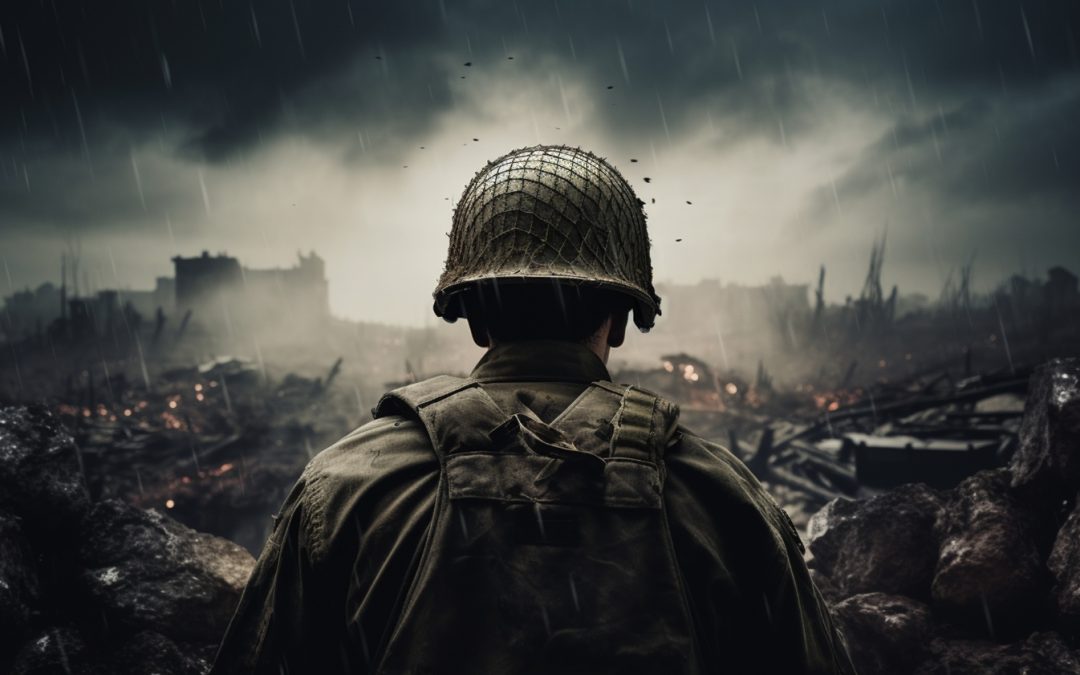
How would Buddhism see D-Day? This is a complex question that invites us to examine the tragic and transformative events of June 6, 1944, through a spiritual lens. For many, D-Day represents bravery and sacrifice. For Buddhists, it may also raise profound questions about violence, suffering, and the conditions that give rise to war.
This article explores Buddhism’s view on D-Day by examining core teachings on violence, compassion, karma, and liberation—while also addressing the broader sociological dynamics of war and morality.
Understanding D-Day in Historical Context
D-Day refers to the Allied landings in Normandy during World War II, marking a pivotal moment in the defeat of Nazi Germany. It involved massive military coordination, human loss, and destruction. Over 150,000 troops stormed the beaches, facing resistance and enduring unimaginable hardship.
From a sociological standpoint, D-Day was not just a military event—it was part of a broader system of ideological conflict, nationalism, and geopolitical restructuring. Buddhism invites us to see beyond binary good-versus-evil narratives and instead examine the root causes of suffering.
Nonviolence and the First Precept
Central to Buddhist ethics is the first precept: to abstain from taking life. This foundational vow reflects a deep commitment to nonviolence (ahiṃsā) and reverence for all sentient beings.
From this perspective, D-Day—as a moment of widespread killing—poses an ethical paradox. While many view it as a “necessary evil” to stop greater atrocities, a Buddhist lens questions whether violence can ever truly bring peace.
Even in cases of defensive warfare, Buddhism emphasizes that hatred cannot be overcome by hatred. As the Dhammapada states: “Hatred is never appeased by hatred in this world; by non-hatred alone is hatred appeased.”
Compassion Amidst Conflict
Yet Buddhism is not blind to the realities of human suffering. On D-Day, many soldiers risked their lives to liberate others from tyranny. Some Buddhists might see this as an act of compassionate courage, despite the karmic consequences involved in killing.
The Mahāyāna tradition allows room for compassionate action in morally complex situations. A bodhisattva, for example, might take on suffering or commit difficult acts to protect others—while still being aware of the karmic burden and seeking purification.
This interpretation doesn’t glorify war but acknowledges the moral complexity of choice under duress.
Karma and the Cycle of Suffering
From a karmic perspective, Buddhism sees war not as an isolated event, but as the result of collective actions, intentions, and delusions. D-Day arose from decades of political strife, colonialism, hatred, and ideological rigidity.
Buddhism encourages us to look at the causes and conditions (pratitya-samutpada) that lead to conflict. Greed, hatred, and ignorance (the three poisons) are not only personal traits—they can become embedded in institutions and systems.
This framework helps explain why societies repeat patterns of violence and domination, and why true peace requires more than military victory—it demands inner and structural transformation.
Rebirth, Suffering, and Moral Responsibility
Another dimension of Buddhism’s view of D-Day is the understanding of rebirth and karmic consequences. Those who died—civilians and soldiers alike—did not vanish into nothingness. Their consciousness, according to Buddhist thought, continues, shaped by the moral quality of their actions and intentions.
This leads to a more compassionate, rather than heroic, view of war. It is not just about victors and vanquished, but about beings trapped in samsāra, experiencing cycles of fear, violence, and loss.
Even those on the “right side of history” carry moral responsibilities. Buddhism calls on us to cultivate wisdom, restraint, and compassion—even when facing grave injustice.
Collective Trauma and Social Healing
On a sociological level, events like D-Day leave lasting imprints on societies. Generations inherit collective trauma, nationalism, and binary identities. Buddhism encourages practices that go beyond memory or commemoration—to actual healing.
These include:
- Mindfulness and remembrance that honours all lives lost
- Compassion meditation (karuna bhavana) directed toward former enemies
- Non-identification with nationalistic narratives that perpetuate division
Healing from war requires seeing the humanity of all involved and acknowledging the universal suffering caused by ignorance and fear.
What Can We Learn From a Buddhist View of D-Day?
A Buddhist reflection on D-Day does not seek to erase its historical or moral significance. Instead, it offers a wider lens—one that asks:
- What karmic conditions led to this moment?
- What suffering was perpetuated, and what was alleviated?
- How can we cultivate the causes of peace moving forward?
Ultimately, Buddhism invites us to replace pride with humility, judgment with compassion, and heroism with responsibility. Only then can we truly honour the past while shaping a more awakened future.
Conclusion: Remembering D-Day With Mindfulness
How would Buddhism see D-Day? As a deeply sorrowful event rooted in collective suffering, but also as a chance to awaken. While courage and sacrifice should be honoured, the Buddhist path urges us to go further—to break the cycles of violence, to see through the illusion of “us vs. them,” and to plant the seeds of compassion, wisdom, and peace.
Reflect. Remember. And take action rooted in awareness and love.